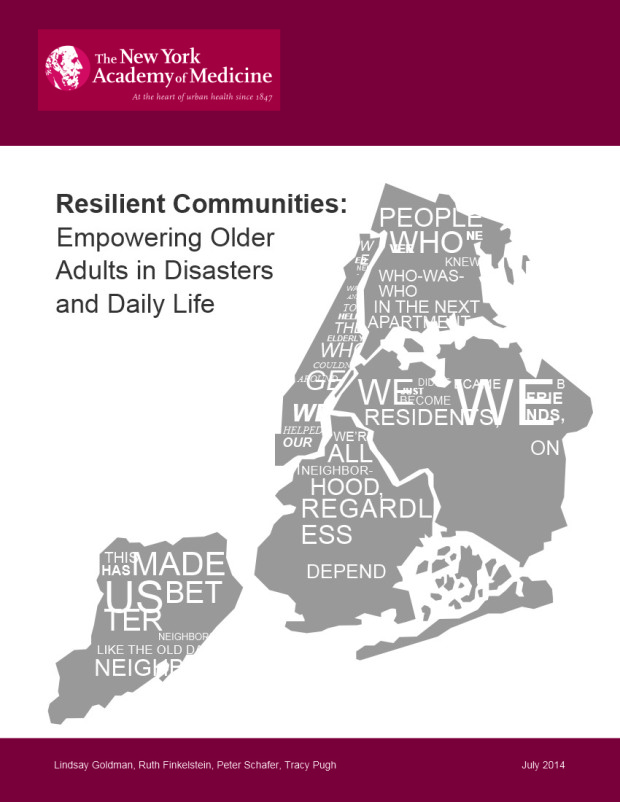
This report has reviews the impact of disaster incidents “that are never going to happen” on older adults and vulnerable populations … and it sets recommendations to improve to a better state of preparedness.
“In more resilient (communities), neighbors talk to and check on one another. Institutions across sectors work together and are known and welcoming to all community members. And older people are seen as problem solvers rather than problems to be solved.”
These are just some of the recommendations in this report, “Resilient Communities: Empowering Older Adults in Disasters and Daily Life.” While the report specifically is directed to older adults in the New York City metro, the lessons learned and take-away points are applicable anywhere.
- Older adults in underserved neighborhoods should be trained to identify and link vulnerable people with community assets (e.g., health care, social services, benefits, food) under routine conditions and during emergencies.
- Older adults and informal caregivers should be provided with access to and training on multiple forms of communication and technology.
- Landlords with large concentrations of older adults and mobility-impaired people should be supported in developing plans to meet the needs of these populations in disasters.
- Employees of city services, local businesses, cultural institutions, and others who routinely interact with older adults should be trained in identifying and providing appropriate local health and human service referrals to those who may be in need of assistance before, during, after, and outside of an emergency.
- Communities should be assisted in organizing Community Resilience Hubs housed at the most appropriate and accessible institutions within each neighborhood to facilitate communal planning and multi-sector partnerships, and to serve as a central repository for information and supplies during an emergency.
- Providers of essential services to older adults should develop contingency plans to ensure the needs of their patients and clients will be met during disasters and emergencies. The communities should extend MOUs and set funding policies in advance to enable providers to expand their reach during disasters.
- Systematically co-locate and coordinate mental health, spiritual care, and psychological first aid with non-stigmatized disaster response and recovery services.
- Academia, city agencies, and community-based organizations should develop and implement appropriate metrics to indicate how vulnerable populations are affected by and assisted in disasters.