“Cold cuts: eating, food and being disabled” - disabilitynow.org.uk
“Enjoying food is something most people take for granted but it can be a fraught issue for disabled people. Food lover Mike Shamash reflects on the reasons why.”
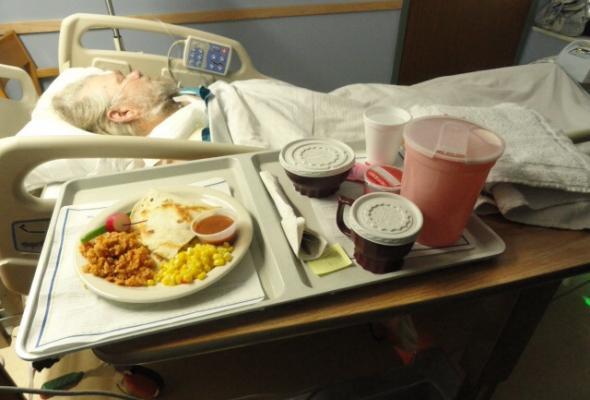
“There are academics who would argue that the human being’s skill in cooking food of using fire to change the taste and texture of raw food is what distinguishes human beings from any other species. Cookbooks are bestsellers and chefs are media stars but as disabled people we may often appear to be rendered invisible by this process.
“As well as being a vital part of life, food is also a rather inclusive activity. Eating is a sedentary, sensuous experience open to all comers. Cooking is only slightly less so. Why then is no mention made of disabled people on cookery programmes?
“There are a range of factors. Disabled people have tight financial budgets and can feel uncomfortable in an environment that says ‘you don’t belong here’, thereby creating a self-fulfilling prophesy of disabled people unwilling to eat out. We often have to filter eating through the historical mist of institutionalisation, eating horrible food in a bleak environment at a time not of your choosing.”
Click here to read this disabilitynow.org.uk article in its entirety.
191 years ago …
 [NOTE: The above image and other Favorite Illustrated, Antique versions of Twas The Night before Christmas are available here.]
“Clement Moore, the author of the poem ‘Twas the night before Christmas,’ was a reticent man and it is believed that a family friend, Miss H. Butler, sent a copy of the poem to the New York Sentinel who published the poem. The condition of publication was that the author of Twas the night before Christmas was to remain anonymous. The first publication date was 23rd December 1823 and it was an immediate success. It was not until 1844 that Clement Clarke Moore claimed ownership when the work was included in a book of his poetry. Clement Clarke Moore came from a prominent family and his father Benjamin Moore was the Bishop of New York who was famous for officiating at the inauguration of George Washington. The tradition of reading “Twas the night before Christmas” poem on Christmas Eve is now a Worldwide institution and tradition.”
Twas the Night before Christmas Poem
Twas the night before Christmas, when all through the house
Not a creature was stirring, not even a mouse.
The stockings were hung by the chimney with care,
In hopes that St Nicholas soon would be there.
The children were nestled all snug in their beds,
While visions of sugar-plums danced in their heads.
And mamma in her ’kerchief, and I in my cap,
Had just settled our brains for a long winter’s nap.
When out on the lawn there arose such a clatter,
I sprang from the bed to see what was the matter.
Away to the window I flew like a flash,
Tore open the shutters and threw up the sash.
The moon on the breast of the new-fallen snow
Gave the lustre of mid-day to objects below.
When, what to my wondering eyes should appear,
But a miniature sleigh, and eight tinny reindeer.
With a little old driver, so lively and quick,
I knew in a moment it must be St Nick.
More rapid than eagles his coursers they came,
And he whistled, and shouted, and called them by name!
“Now Dasher! now, Dancer! now, Prancer and Vixen!
On, Comet! On, Cupid! on, on Donner and Blitzen!
To the top of the porch! to the top of the wall!
Now dash away! Dash away! Dash away all!”
As dry leaves that before the wild hurricane fly,
When they meet with an obstacle, mount to the sky.
So up to the house-top the coursers they flew,
With the sleigh full of Toys, and St Nicholas too.
And then, in a twinkling, I heard on the roof
The prancing and pawing of each little hoof.
As I drew in my head, and was turning around,
Down the chimney St Nicholas came with a bound.
He was dressed all in fur, from his head to his foot,
And his clothes were all tarnished with ashes and soot.
A bundle of Toys he had flung on his back,
And he looked like a peddler, just opening his pack.
His eyes-how they twinkled! his dimples how merry!
His cheeks were like roses, his nose like a cherry!
His droll little mouth was drawn up like a bow,
And the beard of his chin was as white as the snow.
The stump of a pipe he held tight in his teeth,
And the smoke it encircled his head like a wreath.
He had a broad face and a little round belly,
That shook when he laughed, like a bowlful of jelly!
He was chubby and plump, a right jolly old elf,
And I laughed when I saw him, in spite of myself!
A wink of his eye and a twist of his head,
Soon gave me to know I had nothing to dread.
He spoke not a word, but went straight to his work,
And filled all the stockings, then turned with a jerk.
And laying his finger aside of his nose,
And giving a nod, up the chimney he rose!
He sprang to his sleigh, to his team gave a whistle,
And away they all flew like the down of a thistle.
But I heard him exclaim, ‘ere he drove out of sight,
“Happy Christmas to all, and to all a good-night!”
(SOURCE: http://www.carols.org.uk/twas_the_night_before_christmas.htm
“Choir of Alzheimer’s patients sings tunes from memory” - USA Today
People with Alzheimer’s and dementia sing their favorite tunes.(Photo: KARE)
“‘We know that music is stored in a part of the brain that’s last affected by Alzheimer’s disease,’ says Lenard, a former executive director of the Alzheimer’s Association for Minnesota and North Dakota.
“‘The emotions, the joy, the fun, the humor, that came with singing when they were 18 or 24 or 40 comes back,’ Lenard say.
“Among those who joined the choir is Doris Sterner of Edina, who sings next to her daughter Anne.
“Sterner’s medical condition, primary progressive aphasia, causes her words to jumble – a frustrating block to communication.
“‘She can’t say it, but she can sing the songs,’ says Anne Sterner, who exchanges happy glances with her mother, sometimes holding hands, during rehearsals.”
Click here to continue reading this article at USA Today.
“Who Says Elderly Dogs Aren’t as Cute as Pups?” - nextavenue
“This photo project shows these canines have an aging message.”

“Puppies steal people’s hearts. But then they age and cease to elicit as many “awws” as they once did. Canadian photographer Pete Thorne wondered why.
“So the 35-year-old set out to photograph elderly dogs in a project he’s titled: “Old Faithful.” The goal is to show the beauty and grace of older pets. Along the way, Thorne makes you think about how we see these traits in people, too.
“‘All the telltale signs point to a life lived, and there’s a history behind those eyes, even if they are clouded over and aren’t working too well,’ Thorne says. ‘I just think there is so much character to these old doggies’ faces.’”
Click here to read this nextavenue.org article in its entirety.
Feeling frazzled … ’tis the season. Relax.
“Stress and depression can ruin your holidays and hurt your health. Being realistic, planning ahead and seeking support can help ward off stress and depression.” - The Mayo Clinic
Futurity.org has compacted a number of research topics to help understand and cope with holiday stress:
A little stress can make brains sharper
To deal with problems, avoid them (for a little while)
New Olmstead Guidance for Consumers and Advocates As States Implement the New Home Care Rule
 (SOURCE)
“The U.S. Department of Justice’s Civil Rights Division and the U.S. Department of Health and Human Services’ Office for Civil Rights released a joint letter this week offering guidance on the Department of Labor’s new Home Care Rule. The letter describes states’ obligations under Olmstead and the Americans with Disabilities Act (ADA) as they move forward with implementation of the rule in relation to minimum wage and overtime protections for home care workers. Read the letter here: www.dol.gov/whd/homecare/hhs-doj.htm.
“AAPD has been working with other disability and aging groups to ensure that states implement the Home Care Rule in a way that doesn’t cause unintended harm to consumers. The letter helps support that goal by making clear that states planning to comply with the rule by issuing blanket caps on workers’ hours or travel time will be at risk of violating the ADA. Please read Advocacy Steps for Consumers and Advocates Regarding the Home Care Rule: Update on Requirements of the Americans with Disabilities Act and Olmstead to help inform people with disabilities, seniors and advocates in taking action using this new guidance.”
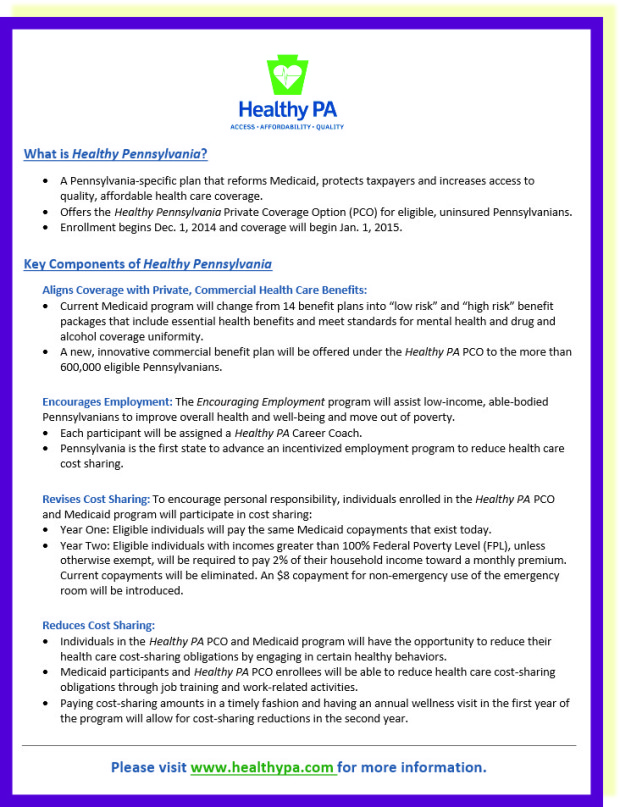
Healthy Pennsylvania
“The Healthy Pennsylvania plan was created in Pennsylvania, for Pennsylvania. It is built upon common sense reforms that provide coverage options to our most vulnerable citizens in a flexible and sustainable way that protects taxpayers. Pennsylvania is home to a world class health care delivery system, and the initiatives in Healthy Pennsylvania focus on three key priorities: improving access; ensuring quality; providing affordability.”
“What you should know about the ABLE Act” - Vox.com
By Justin King
“For many Americans living with disabilities, it has been a good week: now that the Senate passed the Achieving a Better Life Experience (ABLE) Act this week (following the House’s passage in early December) it is now on its way to the President to be signed into law. The ABLE Act creates tax-advantaged savings accounts for use by individuals with disabilities. Critically, savings in ABLE accounts won’t disqualify those individuals from receiving public assistance. While the bill is a win for many individuals with disabilities and their families, there are millions of others who are left out and need additional measures to pursue the same goals — financial security and upward economic mobility.
“What does the ABLE Act do for Disabled Americans?
“The ABLE Act (H.R. 647/S. 313) creates savings accounts for use by individuals with disabilities where deposits are able to grow tax-free. ABLE builds off of an existing part of the tax code that allows states to offer similar accounts, dedicated to post-secondary education, called 529 College Savings Accounts. When ABLE Accounts are created (starting in 2015) qualifying individuals and their families will be able to open an ABLE Account and deposit up to $14,000 annually. As in the 529 model, those funds can be invested with more or less risk and growth potential, according to the vendor, state, and choice of the account holder. ABLE Accounts are effectively limited to $100,000, as larger amounts would cause the account holder to lose eligibility for public assistance.”
Lebanon County Link partners swell to 50 community resources providers

The collaborative partner list in Lebanon County has reached the “half-a-hundred” mark. Click here to see the complete list of core and collaborative partners.
The most recent partners are:
These collaborative partners have boosted the partner network to 50. The Link network of Lebanon County agencies/entities/organizations provides information and resources for persons aged 60 and over; persons with a disability; veterans; family members and caregivers.
If you would like more information about how to become a collaborative partner (there’s no cost) or to align with any county partners’ network in the Berks-Lancaster-Lebanon Service Area, text or call the Lebanon County Coordinator, 717.380.9714.
Or email blllink@mail.com.
There is no charge to become a collaborative partner with the Lebanon County Partners of the Pennsylvania Link To Aging and Disability Resources.
“Congress Passes ABLE Act: Major Victory for Persons With Disabilities and Their Families”
For First Time in Nation’s History, Federal Government Recognizes Added Costs Associated to Living With a Disability
“WASHINGTON, DC-(Marketwired - December 17, 2014) - Last night, the U.S. Senate overwhelmingly passed the Achieving a Better Life Experience (ABLE) Act of 2014 by a vote of 76 to 16. First introduced in 2006, and subsequent sessions of Congress, the ABLE Act will allow people with disabilities (with an age of onset up to 26 years old) and their families the opportunity to create a tax-exempt savings account that can be used for maintaining health, independence and quality of life.
“Today marks a new day in our country’s understanding and support of people with disabilities and their families,” Michael Morris, National Disability Institute (NDI) Executive Director, said. “A major victory for the disability community, ABLE, for the very first time in our country’s policy on disability, recognizes that there are added costs to living with a disability.” He continued. “For far too long, federally imposed asset limits to remain eligible for critical public benefits have served as a roadblock toward greater financial independence for the millions of individuals living with a disability.”
